 Control Tower
 Audit log to your SIEM
Enterprise: sending the audit log to a SIEM needs a Control Tower Enterprise license.
Any export destination can also receive the audit log: every change made in Control Tower, and every attempt that was refused, as it happens. It works with Splunk, Datadog, an OpenTelemetry collector (and through it Elastic, Microsoft Sentinel, Google SecOps and others), an S3 bucket, or any webhook. A destination can receive calls, the audit log, or both.
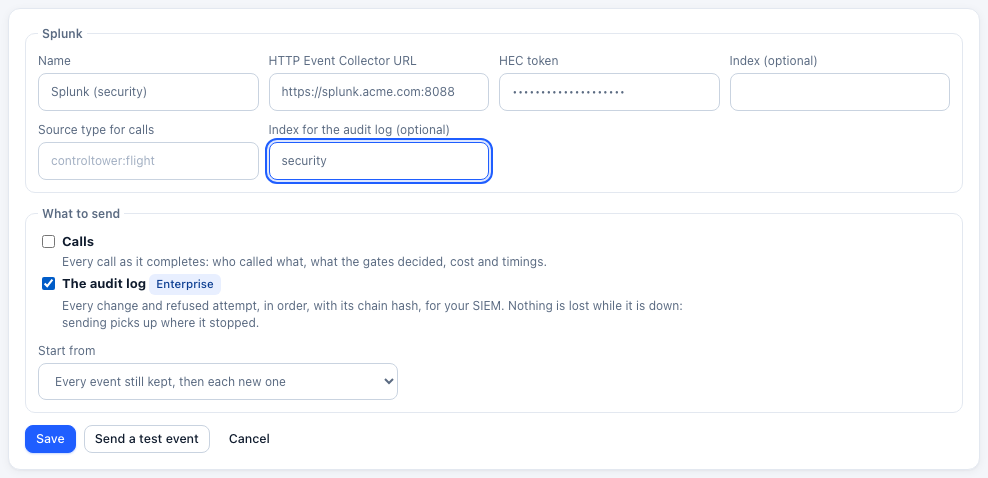
Set it up
- Open Exports and add a destination, or pick an existing one.
- Under What to send, tick The audit log. Untick Calls if this destination is only for security events.
- Choose where to Start from:
- New events, from now on;
- Every event still kept, then each new one, to load the history into your SIEM (up to the retention period, 365 days by default).
- Send a test event checks the settings; then Save.
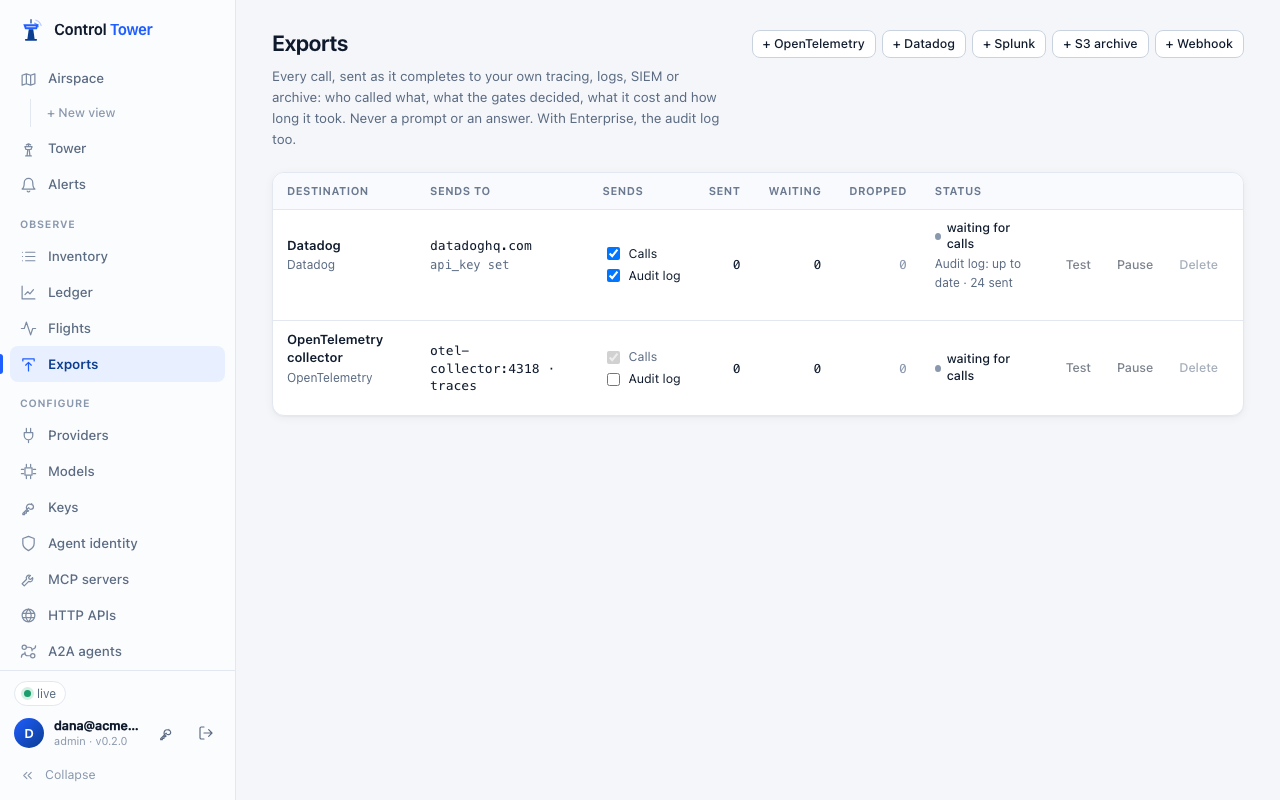
For a destination already saved, tick Audit log in its row. It starts from new events.
The row shows where the destination has got to: up to date, how many events are still to send, or failing with the reason.
What each destination receives
| Destination | Audit events arrive as |
|---|---|
| Splunk | HTTP Event Collector events with source type controltower:audit and the event's own time. The Index for the audit log setting sends them to their own index (for example security); left empty, they go to the same index as calls |
| Datadog | Log intake v2, one log per event. status is info (done), warn (refused) or error (failed), and message reads like dana@example.com providers.create: success (201). Datadog's standard attributes are filled in: evt.name (the action), evt.outcome, usr.id, usr.email, network.client.ip, http.status_code, http.useragent. The whole event is under audit |
| OpenTelemetry | Log records sent to <endpoint>/v1/logs, even when the destination sends calls as traces. Scope controltower.audit; event.name is controltower.audit. Attributes follow OpenTelemetry's conventions (user.id, user.email, user.roles, client.address, user_agent.original, http.response.status_code), plus controltower.audit.action, .outcome, .seq, .hash. The body is the whole event as JSON. Severity is INFO, WARN or ERROR, as above |
| S3 archive | Gzipped JSON Lines files under <prefix>audit/YYYY/MM/DD/HH/, apart from call records |
| Webhook | {"type": "controltower.audit", "count": 2, "events": [...]}, signed with x-ct-signature when the destination has a secret (see checking the signature) |
Each event is the same as in the audit log API: who, what, the outcome, where from, the request with its secrets removed, and the chain fields seq, prev_hash and hash.
Other SIEMs
- Elastic: send to an OpenTelemetry collector with the Elasticsearch exporter, or to Elastic's OTLP endpoint directly.
- Microsoft Sentinel: send to an OpenTelemetry collector with the Azure Monitor exporter, or to a webhook (a Logic App or Azure Function) that writes to a Log Analytics table.
- Google SecOps, Sumo Logic, Cribl, Vector and others: OpenTelemetry or a webhook.
- Amazon Security Lake or Athena: the S3 archive.
Delivery
Control Tower sends from the audit log itself, not from a queue held in memory. Each destination remembers the last event it received:
- Nothing is lost while your SIEM is down. Events wait in the audit log. Sending retries with growing pauses (2 seconds, then up to 5 minutes between tries), and picks up from where it stopped when the SIEM is back. A restart or an upgrade loses nothing either.
- In order. Events arrive in
seqorder, up to 500 per batch, within a few seconds of happening. - At least once. If Control Tower stops between sending a batch and noting it was received, that batch is sent again when it starts. Use
id(orseq) to drop duplicates. - Retention. An event removed by retention before it could be sent (after a SIEM outage longer than the retention period) is counted, and shown as removed by retention before sending. The SIEM sees the gap in
seq. - Several instances. With several instances on one database, one of them sends to each destination. If it stops, another takes over within 30 seconds.
- Without a license, or after one ends, nothing is sent. Each destination keeps its position, and sending resumes from it when a license is added. (Nothing is recorded in the meantime either: see when a license ends.)
Checking the chain in your SIEM
Each event carries seq, the SHA-256 hash of its contents, and prev_hash, the hash of the event before it. With them your SIEM (or an auditor) can check, without access to Control Tower, that no event was changed, removed or put out of order:
seqgoes up by one from each event to the next (a gap is an event not received);- each event's
prev_hashequals the previous event'shash; - each event's
hashis the SHA-256 of this JSON array, written without spaces:
[seq, id, time in milliseconds, actor.type, actor.id, actor.email, actor.role, action, outcome, status,
 target.type, target.id, detail as a JSON string (or null), ip, user_agent, request_id, prev_hash]
In Python:
import hashlib, json
from datetime import datetime

def event_hash(e):
    t = e.get("target") or {}
    ms = round(datetime.fromisoformat(e["time"].replace("Z", "+00:00")).timestamp() * 1000)
    detail = None if e["detail"] is None else json.dumps(e["detail"], separators=(",", ":"), ensure_ascii=False)
    fields = [e["seq"], e["id"], ms, e["actor"]["type"], e["actor"]["id"], e["actor"]["email"], e["actor"]["role"],
              e["action"], e["outcome"], e["status"], t.get("type"), t.get("id"), detail,
              e["ip"], e["user_agent"], e["request_id"], e["prev_hash"]]
    return hashlib.sha256(json.dumps(fields, separators=(",", ":"), ensure_ascii=False).encode()).hexdigest()

def check(events):  # in seq order
    for prev, e in zip(events, events[1:]):
        assert e["seq"] == prev["seq"] + 1, f"missing events before {e['seq']}"
        assert e["prev_hash"] == prev["hash"], f"event {e['seq']} does not follow {prev['seq']}"
    for e in events:
        assert event_hash(e) == e["hash"], f"event {e['seq']} was changed"
A copy in your SIEM, kept by people who can't change Control Tower's database, is evidence that holds even against someone with full access to that database.
API
Destinations are managed through the exports API with three more fields:
| Field | |
|---|---|
send_flights | true (default) to send calls |
send_audit | true to send the audit log. Refused with 402 (enterprise_required, feature siem_export) without a license |
audit_from | now (default) or start (every event still kept), when the audit log is turned on |
curl -X POST https://controltower.example.com/admin/api/exports \
  -H "authorization: Bearer $CT_ADMIN_KEY" -H 'content-type: application/json' \
  -d '{"name": "Splunk (security)", "kind": "splunk",
       "config": {"url": "https://splunk.example.com:8088", "token": "…", "audit_index": "security"},
       "send_flights": false, "send_audit": true, "audit_from": "start"}'
GET /admin/api/exports gives, for each destination with the audit log on, audit: {last_seq, behind, sent, skipped, last_status, last_error, last_sent_at}. POST /admin/api/exports/test with "stream": "audit" sends an example event. POST /admin/api/exports/<id>/flush sends what is waiting now.