 Control Tower
 Providers and models
A provider is an account at a model API: its endpoint and credentials. A deployment is one model on one provider. An alias is a name agents ask for that routes across deployments, with fallbacks. Agents only ever send a model name.
Connect a provider
Providers lists the catalogue: OpenAI, Azure OpenAI, Anthropic, Google Gemini, Google Vertex AI and AWS Bedrock; OpenAI-compatible APIs (Groq, Together, Fireworks, Mistral, DeepSeek, xAI, OpenRouter, Perplexity); and local servers (Ollama, vLLM, LM Studio, or any OpenAI-compatible URL). Other OpenAI-compatible APIs — Cerebras, DeepInfra, NVIDIA NIM, SambaNova — connect as Custom OpenAI-compatible with their base URL, or by name in a config file.
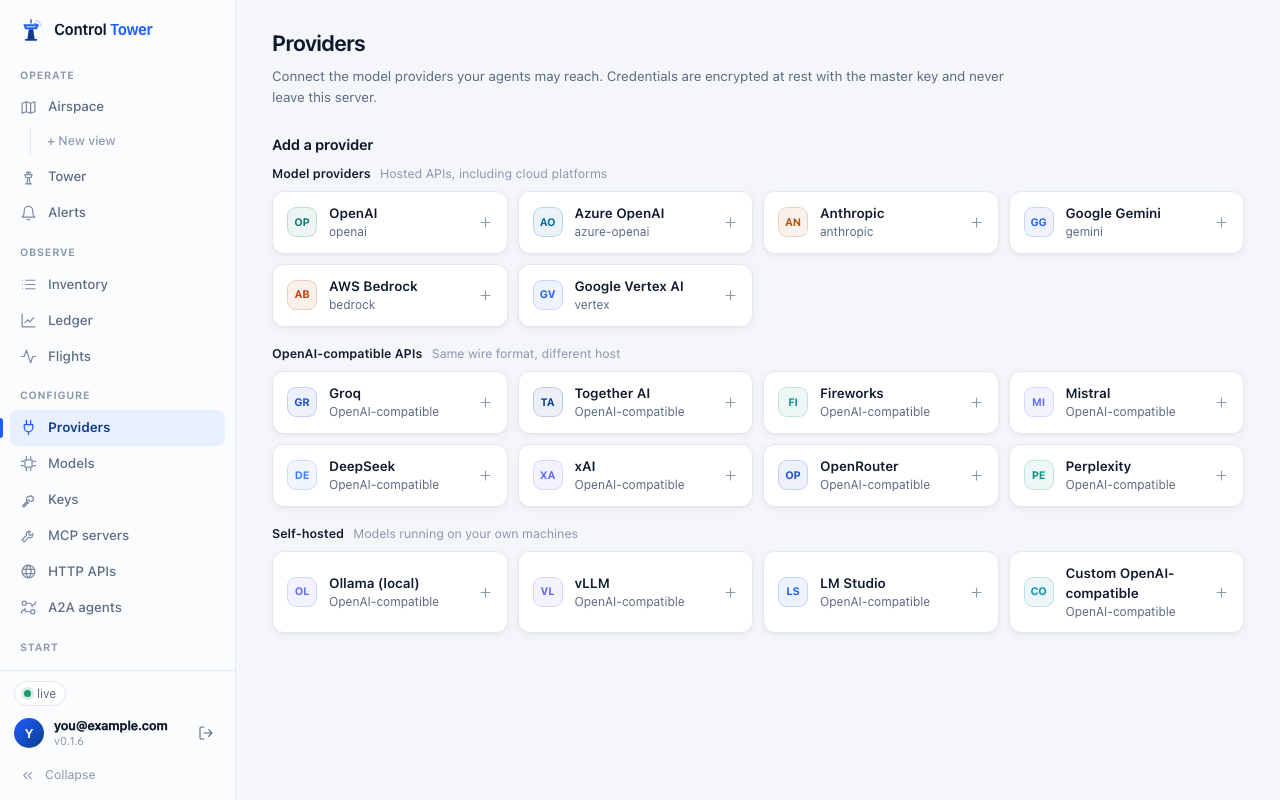
Pick one, paste its credentials and press Connect & test. Credentials are encrypted at rest with the master key (AES-256-GCM, bound to the row) and are never returned by the API or written to logs or events. The base URL is editable for proxies, regional endpoints and local servers.
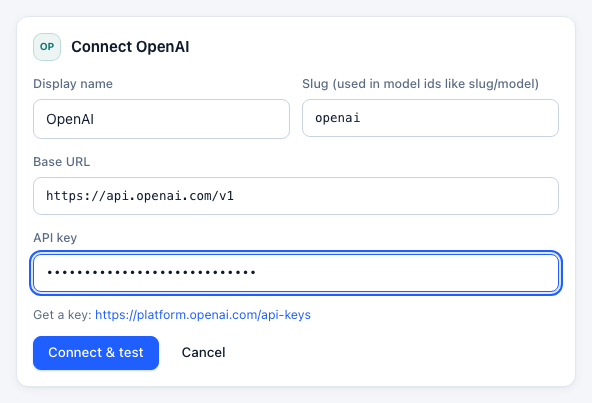
| Provider | Credentials |
|---|---|
| OpenAI, Anthropic, Gemini, OpenAI-compatible | API key |
| Azure OpenAI | API key and resource URL (https://<resource>.openai.azure.com); the API version is editable |
| AWS Bedrock | Access key ID, secret access key and region (SigV4); an endpoint override for VPC endpoints |
| Google Vertex AI | Service-account JSON, project and location |
| Ollama, LM Studio, vLLM | Base URL only (an API key where the server needs one) |
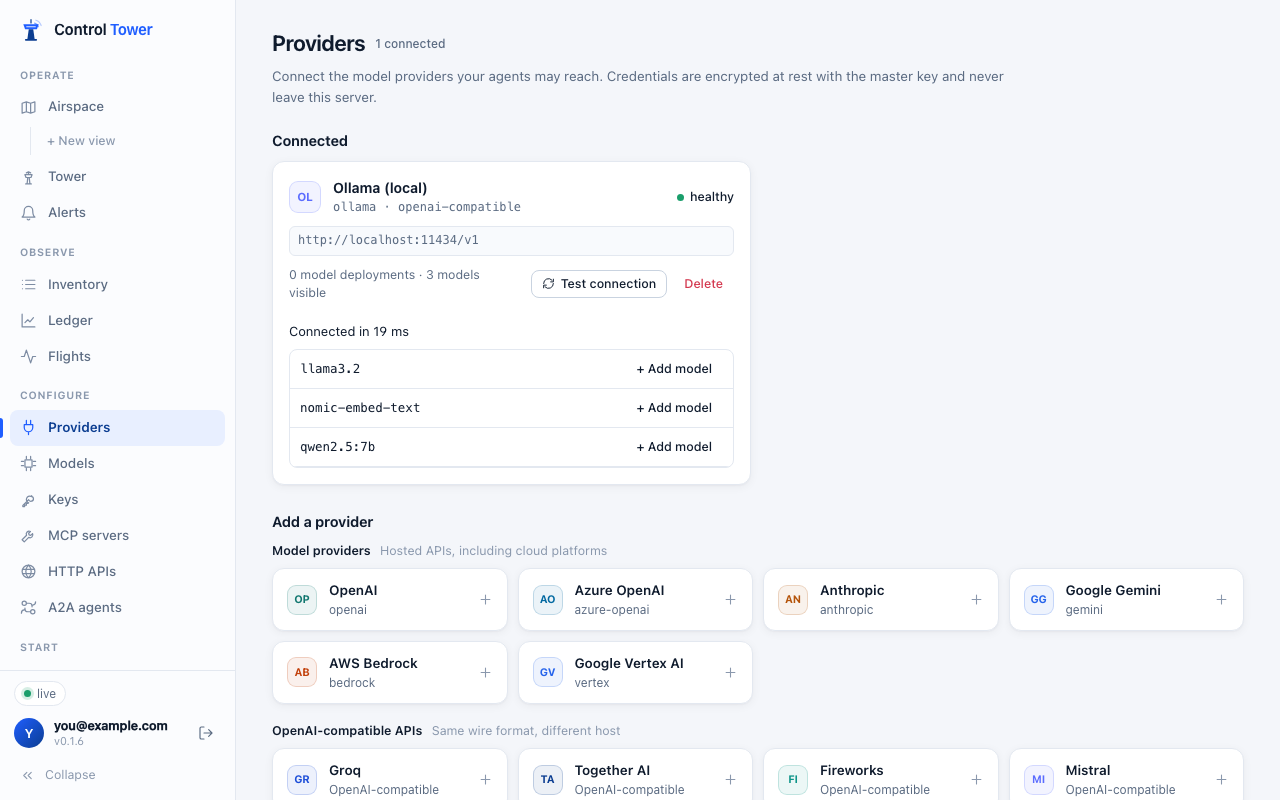
A connected provider shows its health and the models it offers:
Models are added on first use
You don't have to register every model. When a request names a model that no deployment or alias covers, Control Tower looks for a connected provider that serves it — by the provider's own model list, or by the price table — adds a deployment, prices it, and serves the request.
gpt-4.1-mini,claude-sonnet-4-5,llama3.2… resolve to whichever connected provider offers them.<provider-slug>/<model>pins a provider:openai/gpt-4.1-mini,groq/llama-3.3-70b-versatile.- A key's allowed-models globs are matched against the name the agent sends. A key limited to
gpt-4.1*can ask forgpt-4.1-minibut notopenai/gpt-4.1-mini; use*gpt-4.1*to allow both. - A name nobody serves fails with
404 model_not_foundand says which provider to connect. - Stand-in demo providers never adopt models, so demo traffic can't reach real providers.
CT_AUTO_MODELS=0turns this off: every model must then be added under Models.
Deployments
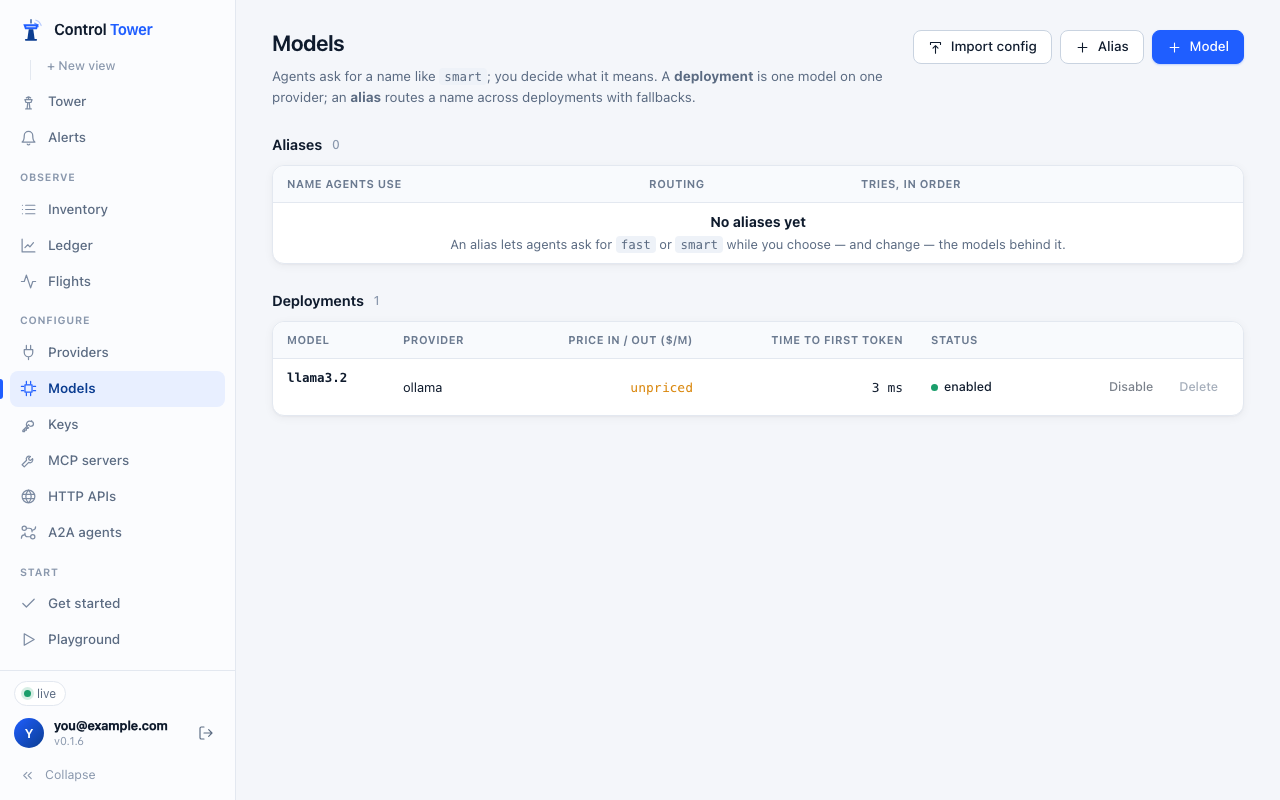
Models → + Model (or + Add model on a provider) adds a deployment explicitly. Use it to:
- rename a model — the public name is what agents ask for (
vertex-gemini→gemini-2.5-proon Vertex AI); - override the price (per million input / output tokens) for negotiated rates or models missing from the price table;
- disable a model without deleting it.
Prices come from a bundled table of about 1,800 models, refreshed with releases. Each request is priced once, at the rate in force when it was routed, and stored in integer nano-dollars. A model without a price is shown as unpriced; budgets still charge an input-side estimate for it, so an agent can't drain a budget through a provider that doesn't report usage.
Aliases, load balancing and fallbacks
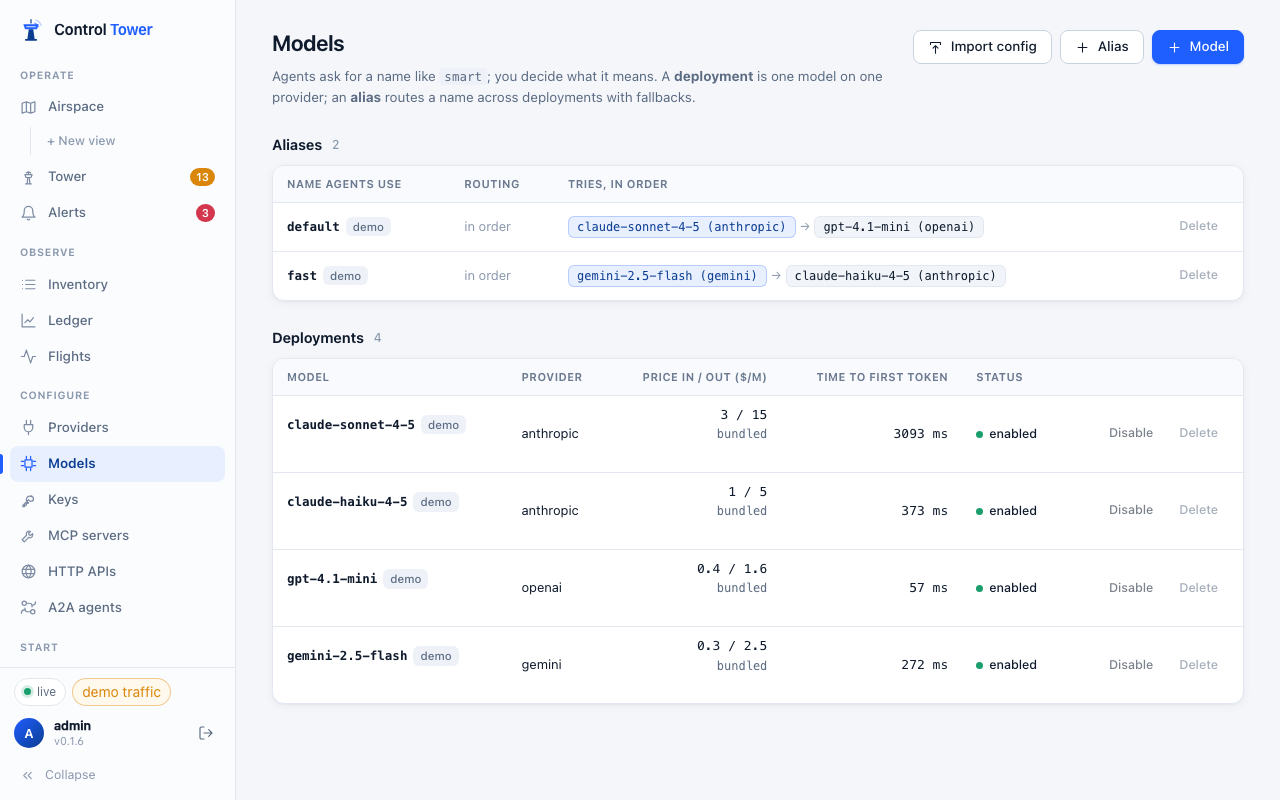
Models → + Alias gives agents one name — fast, smart, default — for several deployments.
| Strategy | Picks |
|---|---|
| priority | The first healthy deployment in the list; the rest are fallbacks in order |
| weighted | At random in proportion to weight among the deployments with the best priority, for spreading load across keys, regions or providers; the rest are fallbacks |
| least latency | The deployment with the lowest recent time to first token among those with the best priority; ones with no measurement yet go last. Later priorities stay fallbacks |
| least cost | The cheapest among those with the best priority, by the price of a typical call (input price × 3 plus output price, per million tokens); deployments without a known price go last. Later priorities stay fallbacks. Set with routing_strategy: cost-based-routing in a config file |
In the console, the order you click deployments in is the fallback order for priority; with the other strategies they all share the best priority. Through the API, give each target a priority (lower is tried first) and a weight.
- A request falls back to the next deployment on rate limits (429), server errors (5xx), timeouts and provider authentication failures — never on a policy decision or an ordinary 400 — and only if nothing has been sent to the client yet, up to three attempts (see attempts in all below).
- A deployment that fails is cooled down (2 s, doubling to 30 s) and skipped while others are healthy; the next success resets it.
- Aliases cross providers: an alias can fall back from OpenAI to Anthropic, and the request is translated.
When a call fails: retries and fallback models
Routing on an alias (or on a deployment agents call by its own name) sets what happens when its deployments can't answer:
| Setting | |
|---|---|
| Prompt too long → try | Models with a larger context window. Deployments whose window the prompt can't fit are skipped before the call is made (the window comes from the price table, or from the deployment's own setting); when a provider refuses a prompt as too long, only candidates with a larger window are tried next, then these models |
| Content refused → try | Models to try when a provider refuses the content (a content filter or safety system). Other deployments of the same model are not tried: they would refuse it too |
| Anything else → try | Models to try once every deployment has failed otherwise — rate limited, down, timed out |
| Retries on 429 / timeout / 5xx | How many times to try the same deployment again, with a short backoff (250 ms, doubling up to 4 s), before moving on. Default 0 |
| Attempts in all | A cap on tries, fallback models aside (default 3) |
Fallback models are still subject to the key's allowed models and to your gates: a fallback that a gate would deny or hold is skipped. Each call is priced as the deployment that answered it. A request too long for every candidate, with no fallback, is refused before any call: 400 context_window_exceeded.
A deployment's own settings
Routing on a deployment also sets:
| Setting | |
|---|---|
| Region | Where the provider serves it (eu-west-1, swedencentral). Without one, the provider's region applies (Bedrock's, or a region set on the provider) |
| Reserved for tags | Requests carrying one of these tags are routed here, and requests without one aren't — unless one of the tags is default |
| Context window | For models the price table doesn't know |
| Requests / minute, tokens / minute, at a time | The deployment's own limits, across every agent. A call that would go over them goes to the next candidate instead; when none is left, it is refused with 429 deployment_busy |
| Wait for an answer | How long to wait for the provider's first byte (default 60 s) |
Keeping data in a region
A key's allowed regions (region globs: eu-*, swedencentral) keep its calls on deployments in those regions; a model with no deployment there is refused with 403 region_not_available, never served elsewhere. A request can also ask for a region with an x-ct-region header — within the key's regions, or it is refused with 403 region_not_allowed.
Routing by tag
Requests carry tags in an x-ct-tags header (comma-separated) or "ct": {"tags": [...]} in the body. When some of an alias's deployments are reserved for a request's tag, the request goes to them — a batch tag to the deployment kept for batch work, say. Tags also break spend down in the Ledger; see Keys.
Health checks
Every five minutes (CT_MODEL_HEALTH_INTERVAL_S), each connected provider is asked for its models, so a model that stops answering shows before an agent's call fails on it:
- A provider that doesn't answer — unreachable, refusing its credentials, or failing — marks its models down. One that simply has no model list isn't.
- A model its provider no longer lists is not offered (OpenAI, Anthropic and OpenAI-compatible providers, whose lists name models exactly).
- A deployment with
health_probe: truein its settings gets a real one-token call instead — for providers that list models they won't serve (a spent quota, a model not enabled in a region). Check on the Models page does that for any model, now.
A model that is down or not offered shows in red on the map and in its Needs attention list, and on the Models page. Calls still reach it when nothing else can serve them, but an alias tries its healthy deployments first. Health alerts fire on it (outage) and when it comes back (recovered). With several instances, one does the checking and the others read the result.
Caching answers
Cache answers in a model's routing keeps its answers for that many seconds and serves an identical request from the cache: no call to the provider, and no cost. It is off unless you turn it on, per alias or model.
- The cache is only consulted after the call has passed its gates and inspection, so a cached answer is never a way around a gate; answers are stored after inspection of what came back.
- Answers are kept per agent (key). Agents share cached answers lets every agent calling the model use them.
- Streamed answers are kept whole and sent again as a stream; embeddings are cached too. Answers larger than 8 MB aren't kept.
- A request can say
x-ct-cache: no-cache(don't use the cache, but keep the answer),no-store(don't keep it),ttl=<seconds>ornamespace=<name>(keep separate caches, e.g. per evaluation run) — or the same in the body as"ct": {"cache": {"no_cache": true}}. - Responses carry
x-ct-cache: hitormiss. Flights answered from the cache are marked cached and cost nothing. - The cache is in memory, or in Redis when several instances share one. Clear cached answers on the Models page (or
DELETE /admin/api/cache) empties it.
Import a config file
Models → Import config takes a config.yaml, shows what it becomes — providers, deployments, aliases from model groups and fallbacks, MCP servers — asks for any secret it can't resolve, and imports it once.
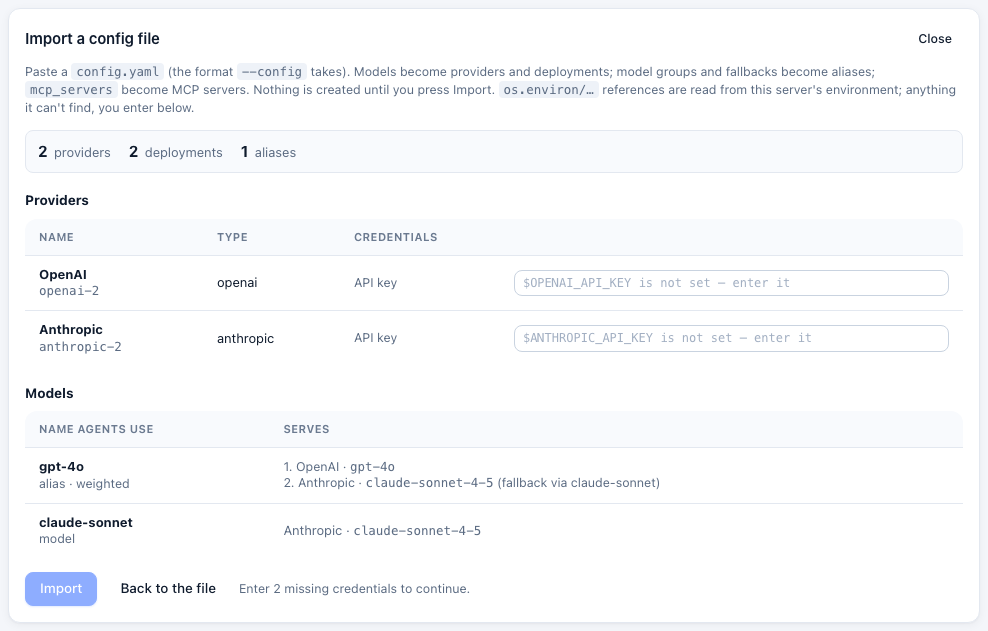
To keep the file as the source of truth instead, start the server with --config; see Config file.
API
The console uses /admin/api/providers, /admin/api/deployments and /admin/api/aliases. With the admin key, scripts can also use the model management endpoints: GET /model/info, POST /model/new, POST /model/delete.